Sand Art Sends a Global Message of Peace as Bodh Gaya Hosts Historic International Buddhist Festival
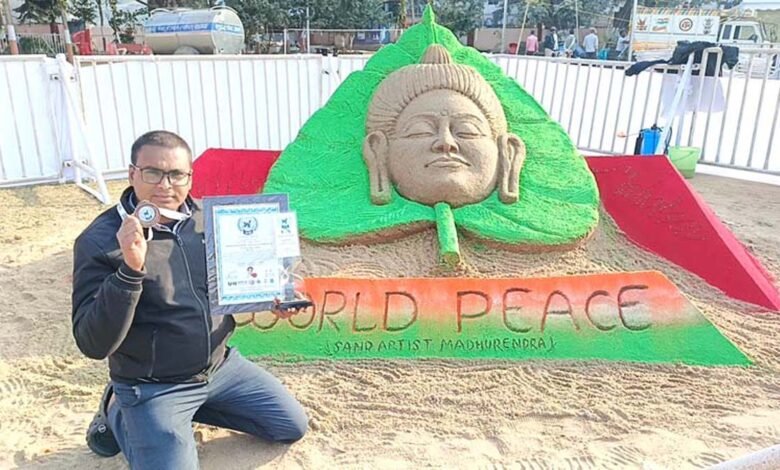
Bodh Gaya, India: The sacred Buddhist town of Bodh Gaya became a global center of peace during the International Buddhist Festival as renowned sand artist Madhurendra Kumar created record-breaking Buddha sculptures, earning recognition from the UN Book of World Records.
Report by Mukesh Bhartiy for India News Reporter Desk
Bodh Gaya (Bihar): The sacred land of enlightenment, compassion, and liberation Bodh Gaya once again emerged as a powerful global symbol of peace as the International Buddhist Festival unfolded at the Kalchakra Ground. This year, the festival transcended the boundaries of culture and religion, delivering a silent yet profound message of non-violence, coexistence, and universal harmony through an extraordinary artistic expression carved entirely out of sand.
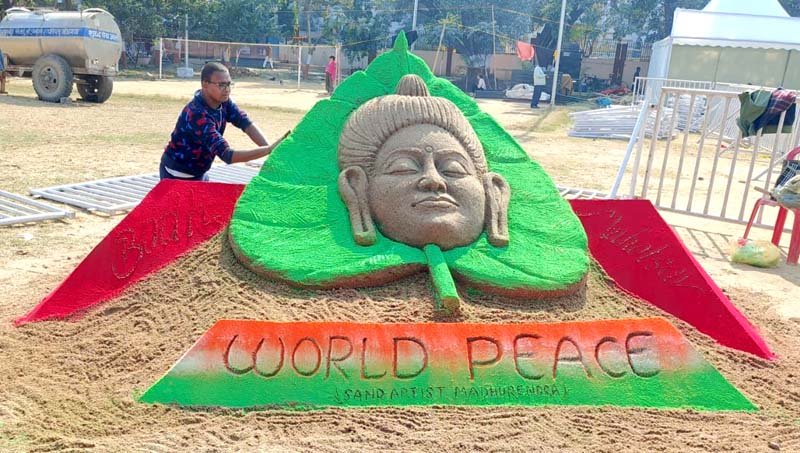
At the heart of this historic gathering stood the breathtaking sand art creation of India’s renowned international sand artist Madhurendra Kumar, whose monumental depiction of Lord Buddha transformed millions of grains of sand into a living embodiment of peace. The scene was not merely an artistic spectacle it was a moment of collective meditation for humanity.
A Festival Beyond Celebration
The International Buddhist Festival of Bodh Gaya is not just a cultural event; it is a global dialogue rooted in Buddhist philosophy. This year’s edition proved to be particularly historic as monks, scholars, pilgrims, artists, and peace advocates from across the world gathered under one spiritual canopy.
Amid chanting sessions, meditation practices, spiritual discourses, traditional dance performances, and interfaith interactions, it was Madhurendra Kumar’s sand art that became the emotional and spiritual epicenter of the festival drawing visitors into a space of reflection and inner stillness.

10 Hours, 15 Tons of Sand, and a 10-Foot Buddha
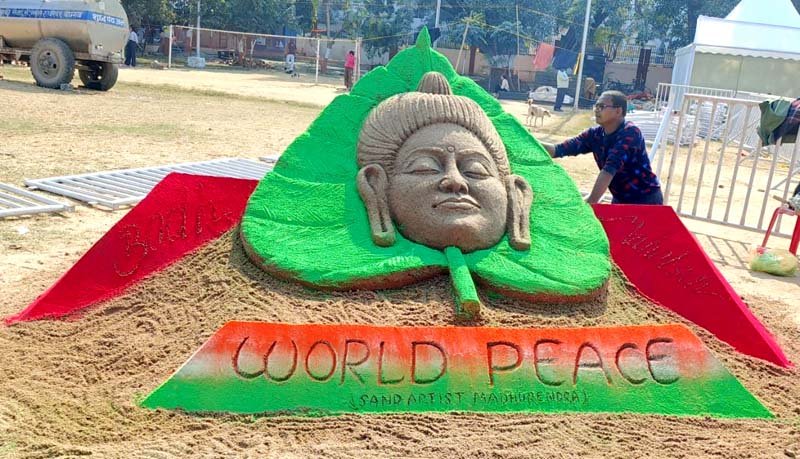
As the main attraction of the festival, Madhurendra Kumar devoted nearly 10 continuous hours, working with intense concentration and devotion, to sculpt a 10-foot-tall majestic image of Lord Buddha using approximately 15 tons of sand.
What made the sculpture even more symbolic was its Peepal leaf shape a direct reference to the sacred Bodhi Tree under which Prince Siddhartha attained enlightenment. The serene facial expressions, gentle posture, and spiritual aura of the sand Buddha deeply moved every onlooker.
As the sculpture gradually took form, the Kalchakra Ground echoed with applause, prayers, and the rhythmic chant of “Buddham Sharanam Gacchami.” Monks from various countries, international tourists, devotees, and art lovers stood mesmerized, witnessing the birth of tranquility from fragile grains of sand.
The Entire Life of Buddha Carved in Sand
This year, Madhurendra Kumar went far beyond a single sculpture. In an unprecedented artistic effort, he portrayed the complete life journey of Lord Buddha through sand.
From the birth of Prince Siddhartha in Lumbini, his royal upbringing, renunciation of palace life, years of intense meditation and penance, attainment of enlightenment at Bodh Gaya, the first sermon at Sarnath, and finally Mahaparinirvana at Kushinagar every major phase was depicted through nearly 50 unique sand sculptures.
This rare and ambitious visual narration left visitors emotionally overwhelmed and spiritually enriched, turning the exhibition into an open-air museum of Buddhist philosophy.
Global Recognition: Entry into UN Book of World Records
Madhurendra Kumar’s extraordinary contribution received international recognition when the UN Book of World Records officially acknowledged his achievement.
The International Coordinator of UN Book of World Records, Professor Buhari Issah, conveyed his congratulations via email, stating that the honor was awarded for the creation of 50 sand sculptures of Lord Buddha, symbolizing global peace, non-violence, and harmony.
With this recognition, Madhurendra Kumar became the first sand artist from India to be featured in the UN Book of World Records an achievement that marks a proud moment not just for him, but for Indian art, cultural heritage, and folk traditions as a whole.
A Sea of Devotees at Kalchakra Ground
Organized annually by the Bihar Tourism Department and the Gaya District Administration, the International Buddhist Festival has evolved into a major global attraction.
The Kalchakra Ground was beautifully decorated with Buddhist flags, prayer wheels, and spiritual symbols. Traditional music and dance performances from various Buddhist countries added vibrant colors to the atmosphere. Yet, amidst all activities, Madhurendra’s sand art remained the most visited and photographed site.
Some visitors were seen meditating silently before the sand Buddha, while others captured the moment through photographs and videos attempting to preserve an experience that felt timeless yet fleeting.
Two Decades of Devotion to Sand Art
This was not Madhurendra Kumar’s first contribution to Bodh Gaya. For the past 20 consecutive years, he has been creating sand sculptures of Lord Buddha during the International Buddhist Festival, each year introducing a new theme and deeper message.
In 2023, he created history by sculpting a colossal 20 foot-high and 30 foot-long Buddha using nearly 100 tons of sand. The sculpture carried messages related to water conservation, the Ganga Jal initiative, and the Gaya Ji Dam, earning recognition as one of the largest sand sculptures in North India.
From a Village Riverbank to the Global Stage
Madhurendra Kumar’s journey is a powerful story of determination and self-belief. Born on July 28, 1989, in Barwakala village of Gaya district, he grew up in a modest rural family with limited resources but unlimited imagination.
At the age of just seven, while grazing goats near the Aruna River in his ancestral village Bizabani, he sculpted his first two-foot-tall sand statue of Lord Buddha. The appreciation he received from villagers became the spark that ignited a lifelong artistic pursuit.
Self-Taught, Self-Made
Without any formal training, institutional support, or artistic background, Madhurendra refined his skills through relentless practice, observation, and inner discipline. What began as a childhood pastime slowly transformed into a spiritual practice and eventually, a globally recognized art form. Today, he stands as living proof that talent does not depend on privilege, but on perseverance.
Spreading Indian Culture Across Continents
Madhurendra Kumar has showcased his sand art in Nepal, Bhutan, Sri Lanka, Malaysia, Vietnam, Laos, Japan, Germany, Italy, the Netherlands, Russia, the UK, Scotland, Canada, and the United States, along with numerous Indian states.
In every country, his work has served as a cultural bridge introducing audiences to Indian philosophy, Buddhist teachings, and the message of peace.
Art as a Tool for Social Awareness
Beyond aesthetics, Madhurendra uses sand art as a medium for social and environmental awareness. His creations consistently highlight issues such as climate change, ocean conservation, anti-plastic campaigns, wildlife protection, cleanliness, de-addiction, women empowerment, education, anti-terrorism, patriotism, and global peace.
The temporary nature of sand art, he believes, reflects the fragile balance of nature reminding humanity that neglect today can lead to irreversible loss tomorrow.
A Message from Bodh Gaya to the World
This year’s International Buddhist Festival reaffirmed that even the most delicate grains of sand can carry the strongest message. Madhurendra Kumar’s sand sculptures at Bodh Gaya were not just artistic achievements they were silent proclamations of compassion, non-violence, and coexistence.
As the sun set over the Kalchakra Ground, the sand Buddha stood calm and radiant, reminding the world that the path to peace still leads through Bodh Gaya the land of the Enlightened One.
The story etched in sand will remain etched in hearts, and Madhurendra Kumar’s name will continue to shine in the golden chapters of Indian art history.